Today
20
in History
26
January
February
March
April
May
June
July
August
September
October
November
December
01
Fri
02
Sat
03
Sun
04
Mon
05
Tue
06
Wed
07
Thu
08
Fri
09
Sat
10
Sun
11
Mon
12
Tue
13
Wed
14
Thu
15
Fri
16
Sat
17
Sun
18
Mon
19
Tue
20
Wed
21
Thu
22
Fri
23
Sat
24
Sun
25
Mon
26
Tue
27
Wed
28
Thu
29
Fri
30
Sat
31
Sun
...
05-21-1956
United States drops hydrogen bomb over Bikini Atoll
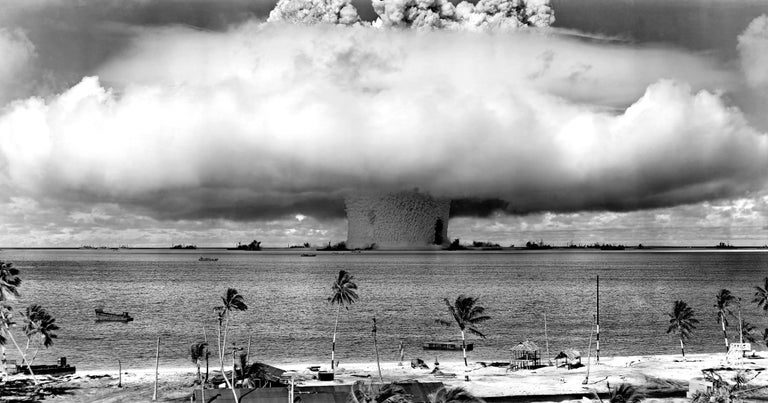
The United States conducts the first airborne test of an improved hydrogen bomb, dropping it from a plane over the tiny island of Namu in the Bikini Atoll in the Pacific Ocean on May 21, 1956. (Because of the time difference, it was still May 20 in the U.S.) The successful test indicated that hydrogen bombs were viable airborne weapons and that the arms race had taken another giant leap forward.
The United States began testing nuclear weapons at Bikini Atoll in 1946. However, early bombs were large and unwieldy affairs that were exploded from the ground. The practical application of dropping the weapon over an enemy had been a mere theoretical possibility until a successful test in May 1956. The hydrogen bomb dropped over Bikini Atoll was carried by a B-52 bomber and released at an altitude of more than 50,000 feet. The device exploded at about 15,000 feet. This bomb was far more powerful than those previously tested and was estimated to be 15 megatons or larger (one megaton is roughly equivalent to 1 million tons of TNT). Observers said that the fireball caused by the explosion measured at least four miles in diameter and was brighter than the light from 500 suns.
The successful U.S. test meant that the ante in the nuclear arms race had been dramatically upped. The Soviets had tested their own hydrogen bomb in 1953, shortly after the first U.S. test in 1952. In November 1955, the Soviets had dropped a hydrogen bomb from an airplane in remote Siberia. Though much smaller and far less powerful (estimated at about 1.6 megatons) than the U.S. bomb dropped over Bikini, the Russian success spurred the Americans to rush ahead with the Bikini test.
The massive open-air blast in 1956 caused concerns among scientists and environmentalists about the effects of such testing on human and animal life. During the coming years, a growing movement in the United States and elsewhere began to push for a ban on open-air atomic testing. The Limited Test Ban Treaty, signed in 1963 by the United States, the Soviet Union, and Great Britain, prohibited open-air and underwater nuclear testing.
More news today
loading...